
EXEN is committed to the long-term development of esports both in Central Finland and at the national level. In Jyväskylä, EXEN organizes gaming club activities for children and young people, as well as goal-oriented, coached competitive programs for dedicated players aged 13 and above.
Topi Kulmakorpi — an expert and EXEN’s Performance Coach as of autumn 2025 — explains how the role of competitive gaming (esports) and physical activity should be considered in a player’s development.
Esports and physical activity: Well-being and performance
Competitive videogame playing (esports) has significantly increased in recent years and is one
of the fastest-growing forms of digital entertainment (Palanichamy et al., 2020; Hamari & Sjöblom, 2017). Despite its virtual environment, esports demands many of the same qualities as traditional sports, including high-level cognitive performance (such as concentration, information processing, working memory, and decision-making), fine motor skills, and fast reaction times. These abilities can also be developed outside the virtual environment—through physical activity.
Esports and well-being
Esports is still frequently viewed through the lens of problematic behavior: players are thought to be exposed to long periods of sedentary activity, which are associated with an increased risk of chronic diseases and other negative health outcomes (Martin-Niedecken & Schättin, 2020). Media portrayals often exaggerate the amount of in-game training undertaken by esports athletes, with reports suggesting as much as 12 hours of daily gameplay practice (Stanton, 2015). This claim is challenged by findings from Kari and Karhulahti (2016), which indicate that elite-level players spend an average of around five and a half hours per day on in-game training. In addition, they often meet or even exceed the World Health Organization’s (WHO, 2020) physical activity recommendations alongside their gaming practice. For these players, physical activity is primarily motivated by health and well-being rather than direct performance gains. Furthermore, a survey conducted by Kari et al. (2019) shows that slightly more than half of high-level esports athletes consider physical activity to be a factor that enhances performance.
Gaming disorder is a WHO-defined pattern of problematic gaming behavior, characterized by impaired control over gaming and the prioritization of gaming over other activities and everyday responsibilities. However, it should not be conflated with goal-oriented or highly competitive video gaming, as the definition does not account for the structured training, discipline, and professionalism required in esports, which in many ways mirror traditional sports (Franks et al., 2022). Nevertheless, goal-oriented gaming should not consist solely of in-game practice; players should also invest in sufficient sleep, a healthy diet, and regular physical activity.
Physical activity as competitive edge
In this context, physical activity does not need to be particularly complex or specific. For example, DiFrancisco-Donoghue et al. (2021) examined the effects of breaking up gaming sessions on executive function and found that a walk of just six minutes had the most positive impact on performance compared with remaining sedentary or continuing to play without a break. One of the greatest competitive advantages provided by physical activity may therefore be the ability to disengage from an intense and stressful game, thereby enhancing the sustainability of effective cognitive performance in both training and official matches. At the elite level, individual differences between players are so marginal that the team or player who maintains cognitive sharpness over a series of matches gains a clear competitive edge. Moreover, physical activity can help offset prolonged periods of sitting and prevent musculoskeletal injuries and overuse-related strain associated with sedentary behavior. For these reasons, developing these habits should begin at a young age, allowing healthy and effective routines to form and create a sustainable foundation for a potential professional career.
Towards a healthier and more sustainable esports culture
Rather than viewing esports as problematic or as a “lesser” form of leisure activity, its inherent potential should be harnessed. Esports offers a unique opportunity to reach a large number of young players and, through this, positively influence their physical activity and health-related behaviors. By doing so, the culture of the sport could be shaped at an early stage toward a healthier, more sustainable, and more ethical direction, enabling further development of both player performance and the discipline as a whole.
Raising the status of esports alongside traditional sports—for example by integrating it into sports academy programs—could elevate the level of Finnish esports and provide young players with additional pathways toward a professional career. Above all, this approach would emphasize the promotion of healthy lifestyles among young players, which should remain a primary objective alongside the growth of the sport itself. Esports-focused organizations play a key role in enabling and normalizing health- and well-being–promoting practices from the junior level onward. There is a clear gap in initiatives and stakeholders dedicated to supporting the physical activity and health behaviors of young video game players, both competitive and recreational.
EXEN is building a sustainable player pathway in Central Finland
EXEN is the only esports organization in Central Finland developing structured player pathways. EXEN’s goal-oriented Counter-Strike player pathway was modeled by Gennady Chernyshev as part of his thesis in 2024. This framework has now been expanded through Kulmakorpi’s expertise to include a dedicated performance development pathway.
The model is applied comprehensively across all of EXEN’s guided gaming activities. Operations are developed systematically from the junior level toward professionalism, where progress is not based solely on in-game practice, but on holistic performance development.
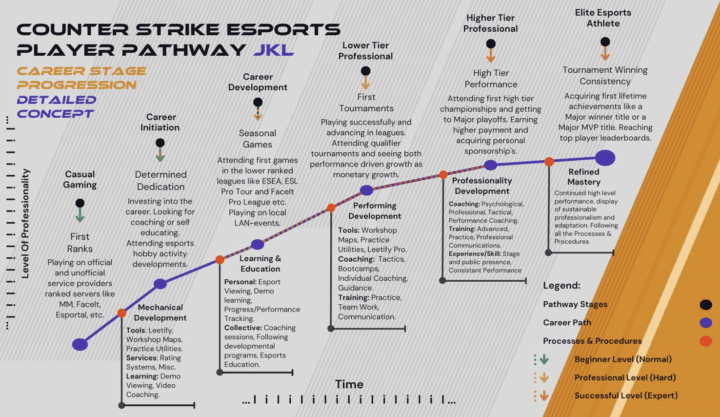
At every stage of EXEN’s player pathway, three key areas are emphasized:
-
Game-specific development – mechanical skills, game understanding, tactics, analytics, and competitive experience
-
Professional growth – communication, teamwork, performance skills, goal orientation, and accountability
-
Everyday performance capacity – physical fitness, recovery, sleep, nutrition, load management, and mental readiness
As Kulmakorpi highlights in his article, esports performance is not built solely in front of a screen. Physical activity and exercise must be integrated into the coaching culture. Players are guided to structure breaks in their practice, maintain general fitness, and build healthy routines from the early stages of their careers.
In practice, this includes periodizing training according to load, incorporating physical activity and recovery into weekly planning, integrating performance-supporting lifestyle habits into structured training, and providing individualized guidance for both game-specific and holistic development.
The core principle of our player pathway is long-term development. Our goal is to build a model in Central Finland where young players can develop safely, purposefully, and sustainably all the way to national and international levels.
When performance is viewed as a physical, cognitive, and social whole, a foundation is created that can withstand both competitive pressure and the demands of a professional career. This is EXEN’s way of developing players — systematically, responsibly, and with a future-oriented mindset.
We hope that in the near future, Jyväskylä will produce competitive players capable of reaching the very top of the global stage.
Sources
DiFrancisco-Donoghue J, Jenny SE, Douris PC, Ahmad S, Yuen K, Hassan T, et al. Breaking up prolonged sitting with a 6 min walk improves executive function in women and men esports players: a randomised trial. BMJ Open Sport & Exercise Medicine. 2021;7:e001118. https://doi.org/10.1136/bmjsem-2021-001118
Franks, R. Robert DO; King, Dominic DO; Bodine, Warren DO; Chisari, Emanuele MD;
Heller, Alan ATC; Jamal, Faraz IV MS; Luksch, John DO; Quinn, Kate DO; Singh,
Raunak DO; Solomon, Mary DO. (2022) AOASM Position Statement on esports,
Active Video Gaming, and the Role of the Sports Medicine Physician. Clinical Journal
of Sport Medicine 32(3):p e221-e229, May 2022. | DOI:
10.1097/JSM.0000000000001034
Hamari, J., & Sjöblom, M. (2017). What is eSports and why do people watch it? Internet research, 27(2). DOI: 10.1108/IntR-04-2016-0085
Kari, T., & Karhulahti, V.-M. (2016). Do E-Athletes Move?: A Study on Training and Physical Exercise in Elite E-Sports. International Journal of Gaming and Computer-Mediated
Simulations, 8(4), 53–66. https://doi.org/10.4018/IJGCMS.2016100104
Kari, T., Siutila, M., & Karhulahti, V.-M. (2019). An Extended Study on Training and Physical Exercise in esports. In B. R. Dubbels (Ed.), Exploring the Cognitive, Social, Cultural, and Psychological Aspects of Gaming and Simulations (pp. 270-292). IGI Global.
https://doi.org/10.4018/978-1-5225-7461-3.ch010
Martin-Niedecken, A. L., & Schättin, A. (2020). Let the Body’n’Brain Games Begin: Toward
Innovative Training Approaches in esports Athletes. Frontiers in Psychology, 11, 138.
https://doi.org/10.3389/fpsyg.2020.00138
Palanichamy T, Sharma MK, Sahu M, Kanchana DM. (2020). Influence of esports on stress: A systematic review. Ind Psychiatry J. Jul-Dec;29(2):191-199. doi:
10.4103/ipj.ipj_195_20.
Stanton, R. (2015, 22.6.). The secret to eSports athletes’ success? Lots – and lots – of practice. ESPN. Lainattu: http://www.espn.com/espn/story/_/id/13053116/esports-athletes-puthours-training-reach-pinnacle.
World Health Organization. (2020). WHO guidelines on physical activity and sedentary behaviour. World Health Organization.